
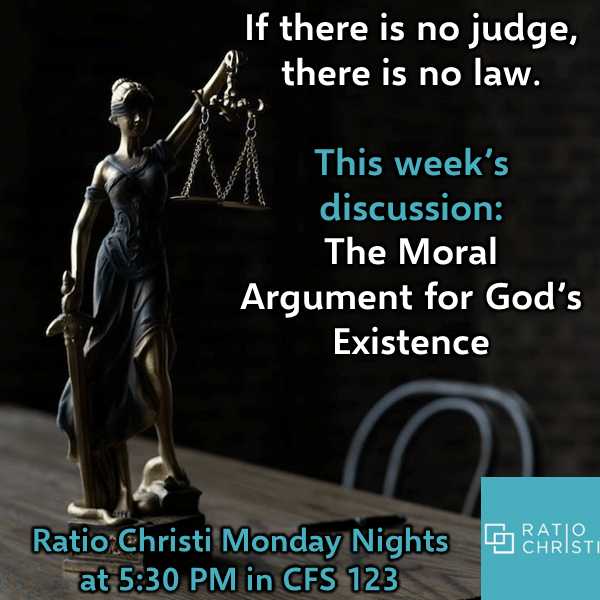
Who could possibly hold all humanity across all of time and in all cultures to a moral standard? This person would have to be above and authoritative over all. We have a name for that person… God.
This line of thinking is the Moral Argument for God’s Existence.
- Premise 1: If there is no God, then there are no objective moral obligations.
- Premise 2: Objective moral obligations exist.
- Conclusion: Therefore, God exists.
This argument is solid, but there are many who challenge it. Premise 1 is strong if Premise 2 stands. Therefore, most challengers go after Premise 2.
Before getting to those challenges, let’s describe what is meant by Objective Moral Obligations.
- Objective – present in the object (the moral act or omission) not in the subject (the person evaluating the moral act or omission). It is thus, mind-independent. It is not subjective or relative, and it is not an opinion.
- Moral – pertaining to right or wrong acts or behaviors
- Obligation – a duty; a required act or behavior which is ultimately punishable if omitted or unfulfilled.
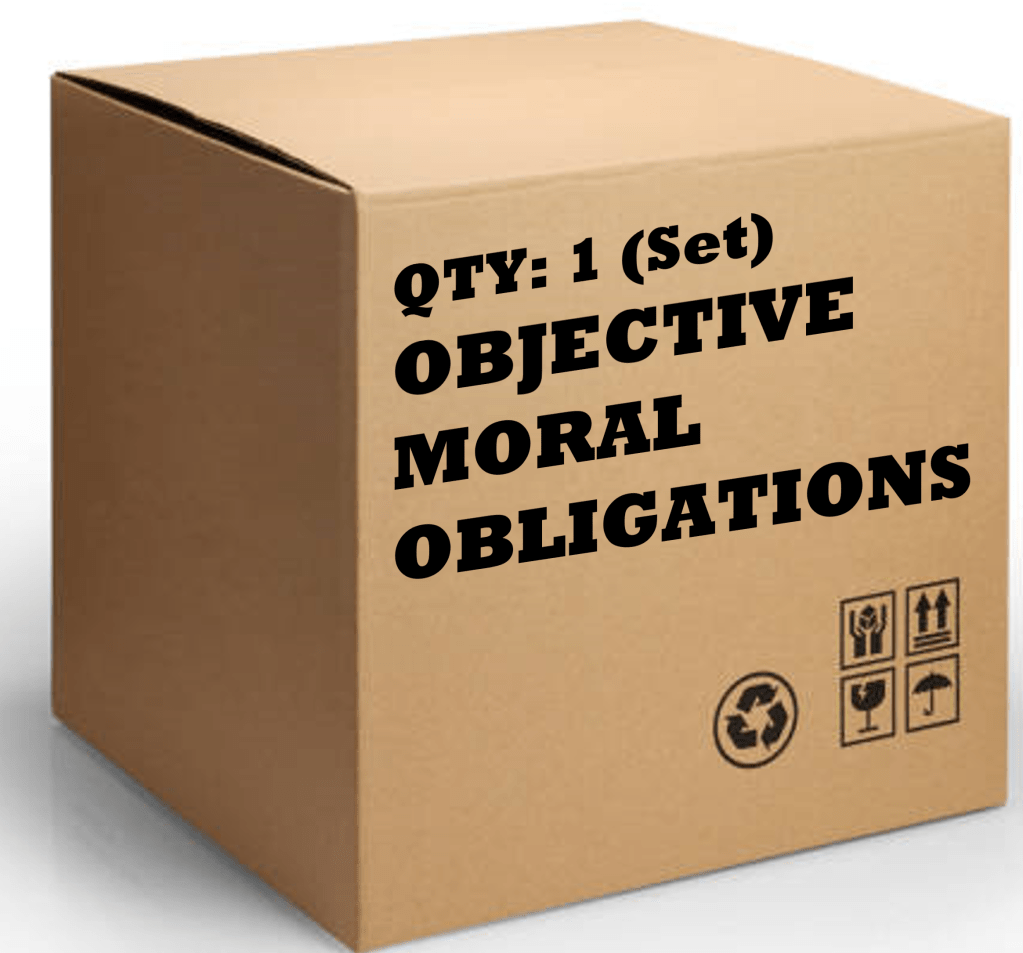
The idea of moral duties is like nails on a chalk board for some. Therefore, they vigorously argue against the idea of Moral Duties.
Here is a summary of the challenges to Premise 2: Objective Moral Obligations exist.
- Individual Moral Relativism – individual moral values
- Social Contract Theory – society-determined moral values
- Social Darwinism – an evolutionary emergence of morality
- Moral Consensus – there is no moral consensus
Let’s explore the problems with each of these objections to Premise 2.
Individual Moral Relativism
This is everywhere these days, even though it should negate the moral outrage we see everywhere. Key phrases present in this view:
- “I feel it is wrong to …”
- “Everyone has their own sense of moral right and wrong.”
- “You have no right to push your morality onto me or anyone else.”
If it is true that there are no universally objective moral obligations, then these statements would be true and would match reality.
However, the REALITY we live in suggests that objective moral obligations exist. All societies across time have had moral indignation against “lawbreakers” even though those laws came about in many different ways – king’s decree, popular vote, social consensus, etc. In fact, if objective moral obligations did not exist we would:
- Lose all justification for moral indignation because things like murder or blatant racism would not be OBJECTIVELY wrong.
- Lose all social and civil agreements because people could betray each other if they felt morally justified in themselves.
- Lose all legal and criminal justice claims because people could simply claim their own sovereign moral code.
No. The philosophy of “You do you” is unlivable (and thus unbelievable).
You can lie and pretend you believe it. But wait until your boss shorts your pay check. You will not accept his claim to a personal subjective morality when it comes to your pay.
Social Contract Theory
Social Contract Theory claims that moral obligations are not objective across all time and cultures. They are obligations to the cultural context one lives in. This fixes some of the problems with “Individual Contract Theory” of Individual Moral Relativism.
Within a culture, one can now feel moral indignation and can enforce civil and criminal penalties for not fulfilling one’s moral obligations.
There are still two enormous problems with Social Contract Theory.
The Nazi Problem – You can’t judge one “Social Contract” against another. Hitler’s Germany had a “social contract” to eliminate the Jews. They saw this as a moral good because of their view that Jews were polluting the Aryan gene pool. They also saw it as moral to eliminate the disabled, calling them “useless eaters” and “life not worthy of life”.
We know that is not right. Why? Because we know there is an OBJECTIVE moral standard that is ABOVE society and culture.
The second problem is the Moral Reformer Problem.
Social (and theological reformers) like Martin Luther King Jr (or Martin Luther) are breaking the social contract and are therefore judged IMMORAL for doing so.
If your view of morality does not give you the ability to praise MLK and criticize Hitler, then it does not correspond to reality. We know better.
Social Darwinism
In the spirit of Rudyard Kipling, the story goes, “Morality emerged by evolution as human societies formed because it provided a survival benefit. And it happened just so.”
This is a very popular view because it sounds so scientific!
However, it has all the above problems plus a few more. If we are (as Richard Dawkins says) merely “dancing to our DNA” then the concept of morality is empty. Hitler was programmed to do what he did. I’m programmed to do what I want, and I have no free will to resist my basest urges. Unless I want to make an argument that my DNA allows me to resist to a point. But I can always use my DNA as an excuse. And as it is my goal to “spread my genes”, I am free to be as selfish as I want.
It doesn’t mean I have to be selfish and “immoral”. Perhaps I want to argue that my DNA gave me a strong sense of morality. But I can’t argue that there is anything OBJECTIVELY right and wrong between my behavior and others.
Once again. Our ubiquitous moral intuition and indignation indicates that this objection to Premise 2 is unlivable and false.
Moral Consensus
This objection to “Premise 2: Objective Moral Obligations exist” is subtle and slippery. It dives into the specifics to show that “no one can agree on the Objective Moral Obligations”. Since there is no consensus on the set of objective moral obligations, then there must not be a set of objective moral obligations.
There are two problems with this claim.
- It assumes that a consensus could be obtained that reflected reality. But this is where the Christian worldview is helpful. Christianity claims that since all of mankind is “fallen” our ability to discern reality with 100% clarity and objectivity is hindered. The Christian is not surprised that mankind disagrees on exactly what moral behaviors and acts are morally right and required. That is why we look to God’s revelation of what is right and wrong in the Scripture.
- Not knowing is not the same as not existing. Just because mankind cannot come up with an identical answer, doesn’t mean that an answer doesn’t exist.
“Premise 2: Objective Moral Obligations exist” is strong.
But as Premise 1 points out, Premise 2 requires an authority which is outside of humanity, able to judge across time and culture. The only candidate for this ultimate Judge is God.
“Do not murder, …But I tell you, everyone who is angry …will be subject to judgment. … “You have heard, Love your neighbor and hate your enemy. But I tell you, love your enemies … Be perfect, therefore, as your heavenly Father is perfect. – Jesus in Matthew 5
We know even in our own society that if there is no Judge, there is no Law. Rioting and mass shoplifting is taking place in cities that have relaxed or eliminated the “judgement” against those activities. Shoplifting is still “against the law” on paper, but without enforcement by a Judge, there is no law in actual practice.
If Premise 2 stands, then Premise 1 stands, too. God is the only authority that could impose Objective Moral Obligations on all of mankind.
Therefore, God exists.
Based on our everyday moral experience, and careful evaluation of the objections, it seems very likely that God has put the law on our hearts.
God’s external revelation in the Bible could have saved us some time, of course.
15 They show that the work of the law is written on their hearts, [Romans 2:15 ESV]
1 Therefore you have no excuse, O man, every one of you who judges. For in passing judgment on another you condemn yourself, because you, the judge, practice the very same things. 2 We know that the judgment of God rightly falls on those who practice such things. [Romans 2:1-2 ESV]
This leads one to wonder,
“What is the purpose or use of the Objective Moral Obligations?”
There are three:
- Curb – the law is a curb on bad behavior and a teacher of what is wrong (and by contrast what is right).
- Mirror – our inability to fulfil the law reveals that we are all guilty of missing the mark. Jesus said in Matthew 5 that we are to be perfect if we are to have fellowship with our heavenly Father.
The mirror of God’s law should cause us immense grief. It should bring us to the foot of the Cross where our guilt was removed and where Jesus paid the price for our rebellious and selfish acts.
3 What the law could not do since it was weakened by the flesh, God did. He condemned sin in the flesh by sending his own Son … as a sin offering, Rom 8:3
Clothe yourselves with Christ, and don’t make plans to gratify the desires of the flesh. Rom 13:14
38 And Peter said to them, “Repent and be baptized every one of you in the name of Jesus Christ for the forgiveness of your sins, and you will receive the gift of the Holy Spirit. 39 For the promise is for you and for your children and for all who are far off, everyone whom the Lord our God calls to himself.” [Acts 2:38-39 ESV]
If you have followed Peter’s invitation, then when God the Father looks at you, he sees his son’s righteousness. You are CLEAN. You are Holy in his sight. - Guide – now that we have been forgiven and are in a right relationship with the ultimate Judge, we seek to please him in thought, word, and deed. Therefore, we look again to the law to see what pleases God.
If God says in his law, “Do not lie.”, then we conclude that God values the truth. Therefore, we should value the truth and strive to be truthful, not merely stopping short of lying. We look to the center of the road, not the curbs. We seek to live rightly, not merely doing all we think we can “get away with”.
It sounds too easy in some ways. Some may ask, “all I have to do is to admit I’m not perfect and that Jesus paid for all my imperfections?”. But admitting we are wrong is literally impossible without God’s help. So, try this out:
Ask God to show you your self-centeredness.
And when he does, ask God to forgive you, acknowledging that the debt was paid on your behalf on the cross.
When you experience God’s forgiveness, everything changes! Continue praying. Read the Gospel of John, then Mark, Matthew, Luke, and Acts. Use the Bible Project to understand the themes in the Bible, and find deep friendship within a Christian Bible-centered Church.
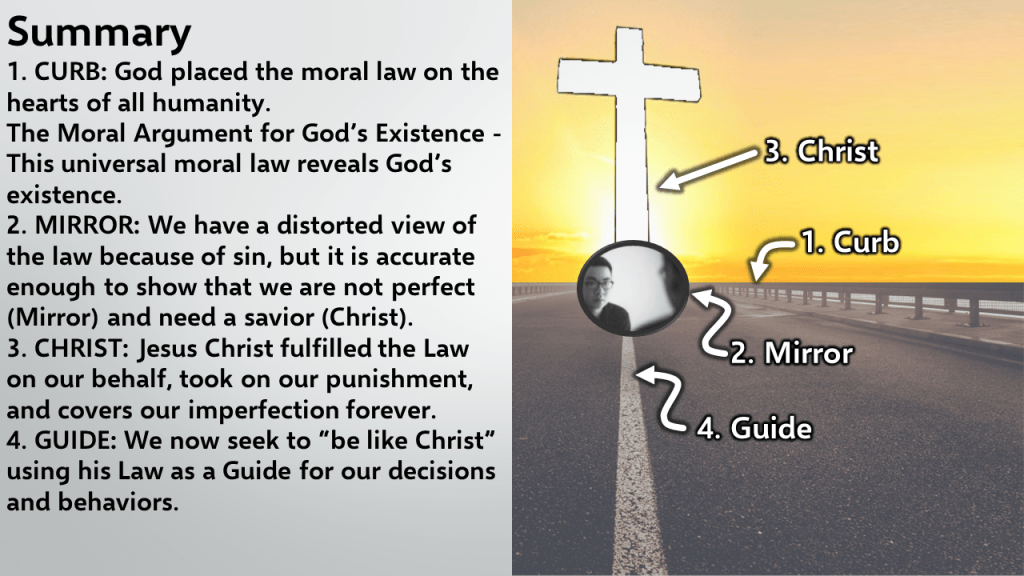
Does this mean you will never stumble over the Curb again?
No. Not on this side of death. But Paul addresses this so well in Romans 7.
18 … For the desire to do what is good is with me, but there is no ability to do it. … 24 What a wretched man I am! Who will rescue me from this body of death? 25 Thanks be to God through Jesus Christ our Lord! Romans 7:18, 24-25
The Law keeps us at the foot of the Cross. Think of the Cross as a window through which God see us as his precious, holy, and perfect children.
That’s a great place to be.
-Darren Williams

